Dit artikel verscheen in FORUM+, pp. 80-89
Collective Signal: A swan song for the air raid siren
Angela de Weijer, Karin Bijsterveld
Collective Signal by Angela de Weijer is a composition originally conceived as a requiem for the air raid sirens in the Netherlands. In 2018, the artist created a proof of concept of the artwork in response to the Dutch government’s intention to dismantle these sirens. Due to delays in the sirens’ end date, the requiem’s performance did not materialize. However, in 2023, a revised version of the work premiered in Germany. This paper presents the biography of Collective Signal from its conception to its premiere as a “breaching experiment” aimed at turning public alarm systems into sound art. It shows how this experiment uncovered the largely hidden sonic conventions behind, training assumptions about, and infrastructural networks linked to the sirens.
Collective Signal is een compositie van Angela de Weijer. Het werk was oorspronkelijk bedoeld als requiem voor het luchtalarm in Nederland. Een concept ervan werd in 2018 gemaakt in reactie op de regeringsaankondiging dat het luchtalarm zou worden afgeschaft. Omdat het einde van de sirenes steeds werd uitgesteld, werd het werk niet uitgevoerd. Een herziene versie ervan kreeg echter een première in Duitsland, in 2023. Dit artikel presenteert de biografie van Collective Signal als een “breaching experiment” dat publieke alarmeringssystemen tot geluidskunst probeerde te maken. Het laat zien hoe het experiment de grotendeels verborgen geluidsconventies, aannames over handelingsinstructies en infrastructurele netwerken rond de sirenes blootlegde.
[to be added?]
Video clip 1: Proof of Concept Video Collective Signal by Angela de Weijer, 2018, courtesy Angela de Weijer.
Audio clip 1: Sample from Collective Signal – Monheim version, 2023, courtesy Angela de Weijer.
On the first Monday of every month, the sounds of sirens fill the air in the Netherlands – always exactly at noon, except for national holidays. The sounds emanate from the testing of 4,278 air raid sirens on poles and roofs located across the country. However, these sound events will probably end soon. Since 2014, several Dutch security ministers have announced the termination of the National Warning and Alarm System (WAS), the siren infrastructure that notifies the Dutch population of large-scale calamities and disasters such as flooding or chemical accidents.1 The ministers consider the sirens expensive and ineffective, aiming to replace them with a mobile phone alert system presently known as NL-alert. Yet each suggestion to abolish the sirens triggers waves of objections, both by those in charge of regional security who express concern about the reach and robustness of the mobile phone alert network, and by those who feel attached to the siren test run sound itself.2
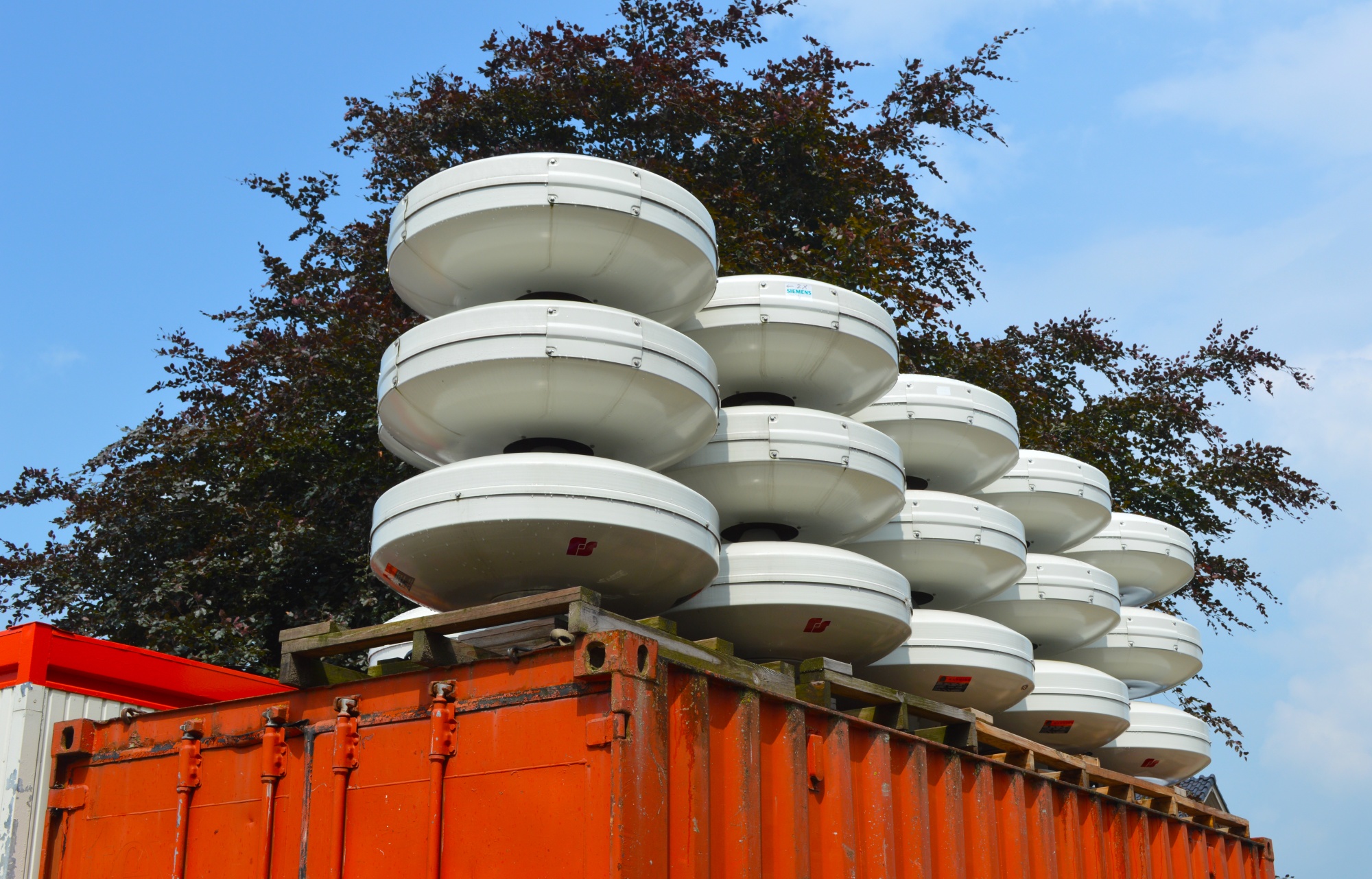
Fig. 1: Storage of sirens at a location in the Netherlands that we cannot disclose, 2018. Courtesy Angela de Weijer.
In 2016, the artist Angela de Weijer, also known as Miss Milivolt, learned of the plans for dismantling the sirens. Mourning the potential loss of the air raid siren sound as sonic cultural heritage, and feeling inspired by compositions like Arseny Avraamov’s 1922 Symphony of Sirens, De Weijer began composing a requiem for the siren entitled Collective Signal, conceived to sound during the sirens’ very last test run. Two years later, she told Karin Bijsterveld, a historian of sound, about her project. Intrigued by De Weijer’s subversive idea, Bijsterveld began digging into the history of the siren in the Netherlands.
Although Bijsterveld’s research was helpful for understanding the origins of the Dutch warning system, the attempts to have De Weijer’s artwork actually sound made the material and immaterial networks in which the sirens function – networks with longstanding or more recent pasts – audible, visible, and palpable in new ways. Preparing for Collective Signal, as we aim to show in this article, worked as a “breaching experiment”: a method introduced in the 1960s by the sociologist Harold Garfinkel, who aimed to open up the mundane and taken-for-granted interactional routines of cultures through natural-setting experiments to examine how things run smoothly in everyday life.3 Examples of such routines are the ways in which people typically greet each other – a potential breaching experiment would be to disrupt this habit with unusual responses to see how this uncovers participants’ assumptions about how “we” should live together.
In this article, we argue that Collective Signal, both as an initial concept and as a sounding composition in public space, was a true breaching experiment. In the Netherlands, the artwork remained a draft composition, while a new version of it premiered in Monheim am Rhein, Germany as Collective Signal – Monheim version. In aiming to turn, and actually turning, public warning systems into artworks, the endeavour uncovered and challenged the largely hidden sonic conventions, public education and infrastructural networks on which the sirens’ functioning depended. This article presents Collective Signal’s biography by showing how the artwork destabilized established sonic repertoires, routines, and networks associated with the sirens, thus laying bare what usually remains out of sight. In contrast with sounding artworks in galleries, museums, and concert halls, Collective Signal’s multiple versions intervened in a critical public infrastructure depending on sound.
Sonic conventions
Today, the siren test run in the Netherlands has three parts. Part I is the “safety sound” transitioning in frequency from 25 to 420 Hertz (Hz) in four seconds, continuing for 26 seconds at that frequency, and then returning to 25Hz within four seconds. Part II is the actual alarm signal, broadcast twice. In eight rounds of climbing and descending sounds that gradually increase in frequency, varying between 25 to 196 Hz and 392 to 784 Hz, the sound reaches its maximum loudness of 123 dB, measured at an eight-metre distance from the source. While climbing up takes 4.8 seconds, descending takes 0.6 seconds. The test of the alarm signal as such takes nearly one and a half minutes.4 Part III repeats the safety sound. The publicly audible part of the test run, however, is limited to the alarm sound.
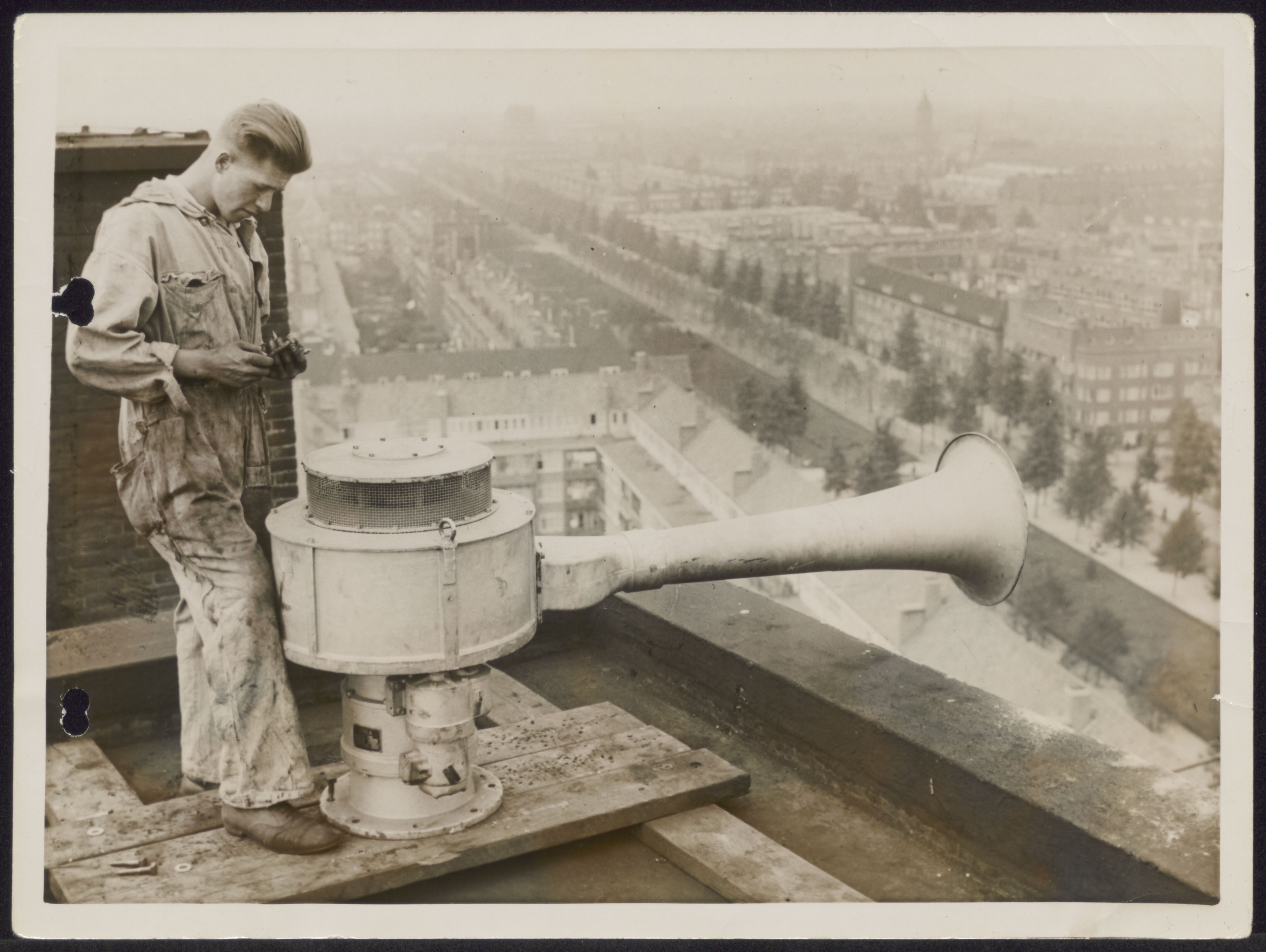
Fig. 2: Installing an air raid siren – although not of the type Zwikker had recommended – on the high-rise building De Wolkenkrabber, Victorieplein 45–47, Amsterdam, 1938. Source: Image Bank (Beeldbank) WO2 Netherlands Institute for War, Holocaust and Genocide Studies (NIOD). Photographer unknown. Courtesy Beeldbank WO2 – NIOD.5
In 2017, De Weijer suggested her idea for Collective Signal to the agency in charge of the air raid sirens, the Institute for Physical Safety (IFV) – renamed Netherlands Institute for Public Safety (NIPV) in 2022.6 The sirens of the Dutch Warning and Alarm System (WAS) were introduced in 1993, and were operational over the entire country as of 1998.7 Siemens had built the system – partially with elements produced by third parties – and maintained it. Initially, each siren had been equipped with a sound generator, using synthesis, connected to speakers in the siren containers. A control unit enabled switching the siren on, selecting a particular sound pattern from a database – or sound library – in the unit. Only the IFV itself had the authority to mandate modifications of the sound library. In such a case, a service engineer needed to upload a new sound library in the control unit.8 By the time De Weijer contacted the IFV, the situation had changed again. Siemens had gradually replaced the early control units with new ones. These units employed digital sampling technology, which allowed playback of a wide range of sounds, including voice-warning messages, provided these remained within the frequency range of the connected speakers.9 This demonstrated that, in principle, the sirens allowed for a much wider range of sounds than they were emitting in the Netherlands at the time.
This made De Weijer aware of the sonic options available. Although she knew that for her projected composition for the WAS system, she would need to take into account the speakers’ frequency range, she initially allowed her imagination to run wild. She presented the result in her 2018 Proof of Concept video, which we recommend watching.
De Weijer composed the Proof of Concept on a Korg Prologue 8 polyphonic synthesizer, imagining a “siren swan song” to measure up to her initial vision of an epic sonic and nationwide event. It aimed to conjure a sense of wonder, inspired by the spectacular sound of science fiction films. The key of this composition is D, the tempo andante (about 80bpm). A smooth sine/saw drone constitutes the foundation and beginning of the piece, a composition strategy frequently used by De Weijer at that stage in her development as a composer. Upon the key sound follows a melody, a saw-tooth wave delivered by two voltage control oscillators, with cutoff filtering for additional dynamic and overdrive as the piece progresses. Finally, an arpeggiator adds a subtle bassline, lending some forward movement and energy to the composition.
De Weijer’s conception of sound deeply clashed with the sonic conventions of sirens. Today’s siren sound shares its climbing and descending tones with the sound of the electric siren that a Delft physicist, Cornelis Zwikker, advised the Dutch government to use as an air raid alarm in 1937. In a context of increasing threat of war, establishing such an alarm was considered of paramount importance. To Zwikker’s ears, the electric siren was capable of creating a wailing sound that was sufficiently loud, menacing, and “irritating” to make it an effective warning signal for the population.10 The howling character of the siren sound distinguished it from the sound of church bells, a common alternative source of alarm at the time, and from the loud ship horns that resounded throughout the Netherlands, a maritime country. Zwikker’s recommendation intended to ensure a siren sound that would slide from the lowest to the highest sound and back again in six to ten seconds. It needed to move up and down between 200-250 Hz and 400-500 Hz. For the main sirens, the required minimum loudness was 90dB, while the maximum loudness had to be 100 dB at the siren source, measured at a distance of ten metres.11 In turn, the electric siren sound drew on the wailing sound of the nineteenth-century mechanical siren.12 The fact that the sound goes gradually up and down is the common thread between the mechanical, electric, and synthesizer air raid sirens in the Netherlands. Creating a proof of concept composition for the air raid siren that intervened in the traditional sequence of siren sounds thus breached sonic conventions, potentially destabilizing the sonic expectations of authorities and civilians alike.
Sonic training
No matter how terrifying a sound appears to be, citizens need training to recognize and accept it as a signal requiring an action of some sort. From the mid-1930s, the Dutch Society for Air Raid Precaution published leaflets and posters instructing the population about what to do when the sirens went off. Their message was, quite simply, to tie up horses or other draught animals somewhere outside, to leave the street, to seek shelter, and to stay away from the windows.13 In the 1939 mobilization effort, the Air Raid Precaution Service was established, which came under the control of Germany during its occupation of the Netherlands in World War II.14
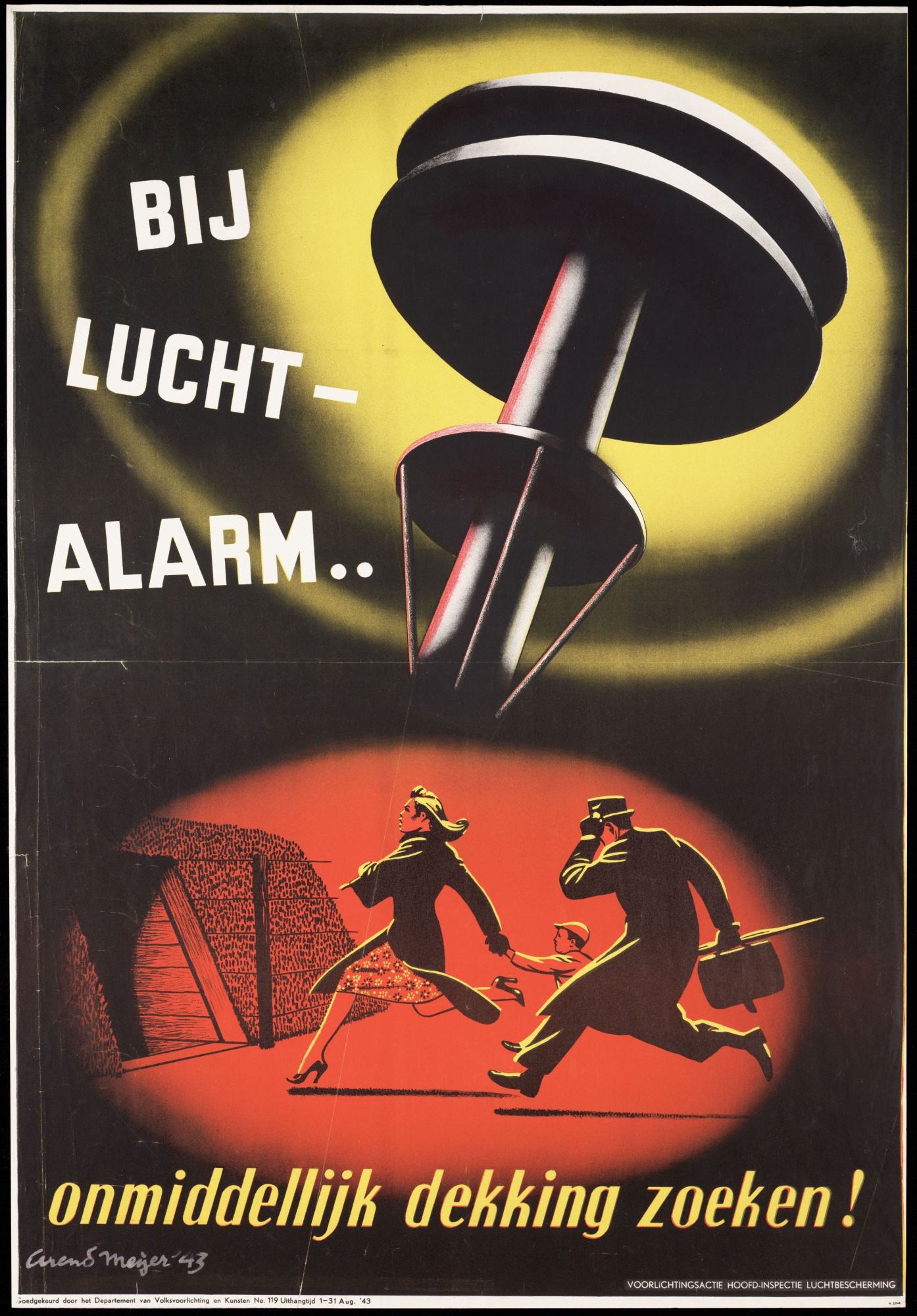
Fig. 3: Poster “In case of air raid alarm … seek shelter immediately!” Commissioned by the Chief Inspector of Air Raid Precaution in 1942, designed by Studio Arend Meijer, and issued by the Department of Public Information and Arts (Volksvoorlichting en Kunsten) in 1943. Courtesy Image Bank (Beeldbank) WO2 – Netherlands Institute for War, Holocaust and Genocide Studies (NIOD).15
However, not all citizens followed the Air Raid Precaution Service’s instructions. Some of them did not want to leave their horses behind, possibly because they depended on their animals as livestock. Others could not suppress their curiosity and wanted to watch the anti-aircraft guns. During World War II, the German occupying forces kept issuing announcements about the need to react accordingly to the siren sound. Apparently, some people saw no danger, or perhaps chose to ignore the siren as a form of protest. Others tried to mimic the siren sound itself as a form of sabotage to create chaos among the Germans. In Zeeland, a largely Protestant province in the South-West Netherlands, local authorities even resisted replacing the church bells – in use as warning and as end-of-danger sign – with the electric siren. The Germans, however, pushed toward a standardization of the warning signal in favour of the siren.16
Yet once such training is rolled out to large parts of the population and the majority accepts the siren sound as a signal prompting the required response, undoing this response will take effort as well. Turning a collective signal into a sound art composition is a breach of “sonic training,” a notion coined by Michael Bull to indicate the repeated instructions to citizens about what they need to do upon hearing the siren alert.17 Training the population to exert such a conditioned response is different from the “aural training” about which Kuseike Yamada has written, using that term to describe how during World War II Japanese schools organized listening exercises that taught their pupils to differentiate carefully between, for instance, the sounds of American or other aircraft.18 Given the history of instructions about the air raid alarm in the Netherlands in the 1930s and 1940s, and subsequent sonic training during the Cold War era, it is unlikely that the Dutch government would have allowed Collective Signal to sound without a prior public information campaign. To prevent potential panic among parts of the population, playing Collective Signal during the very last test run of the air raid sirens would have required a nationwide information campaign to communicate that the sirens would be playing a requiem to mark their ending.
Presenting the sounds of sirens as music or sound art is not unique. As early as the mid-1920s, composer George Antheil used the siren as a musical instrument in Ballet Mécanique, and Edgar Varèse did so in Ionisation (premiering in 1933), to mention two famous avant-garde examples.19 Even a performance with sirens in public space has at least one historical precedent. In 1922, Arseny Avraamov conducted his composition Symphony of Sirens in an open-air performance in the Soviet city Baku, to commemorate the October Revolution. While referencing songs such as the Internationale, Avraamov used factory sirens alongside choirs, foghorns, artillery batteries, steam locomotives, steam whistles, and other loud devices.20 It was, however, a concert meant for one town rather than for an entire country, and thus much more limited in scope than De Weijer’s initial plan for the nationwide siren swan song. Another artwork featuring sirens, Aura Satz’s film Preemptive Listening (2024) – in which twenty artists intriguingly reimagine the sound of the siren – is only available online, in art cinemas and in museums, not in public space. These wonderful pieces of sound art for imaginary sirens did not directly intervene in a functioning public alarm system, as De Weijer has tried to do for the Netherlands, and eventually managed to do in Germany. As we explain below, her artwork intervened in a longstanding, open-air collective warning system. This made all the difference.
Siren maintenance
Who is in charge of the sirens in the Netherlands? When it comes to developing the legal framework for warning and alarm systems: the national government. As for making decisions about the siren’s use: the chair of the security region and municipal authorities, and usually the mayor of the relevant municipality. Maintaining the 4,278 sirens and their infrastructure is the responsibility of the above-mentioned NIPV.
The NIPV leadership did not respond with great enthusiasm when De Weijer contacted them with her initial idea for the requiem. Siemens showed a greater interest in the project, though the materialization of De Weijer’s composition would have marked the end of their contract for maintaining the Warning and Alarm System. A staff member clarified the workings of the sirens, explaining the function of the three white, ellipse-shaped containers of the most common siren design (Fig. 4). Surprisingly, the lowest one is empty, its rounded shape simply reflecting the sound emanating from the middle and upper containers. These two boxes include the speakers distributing the characteristic siren sounds.21
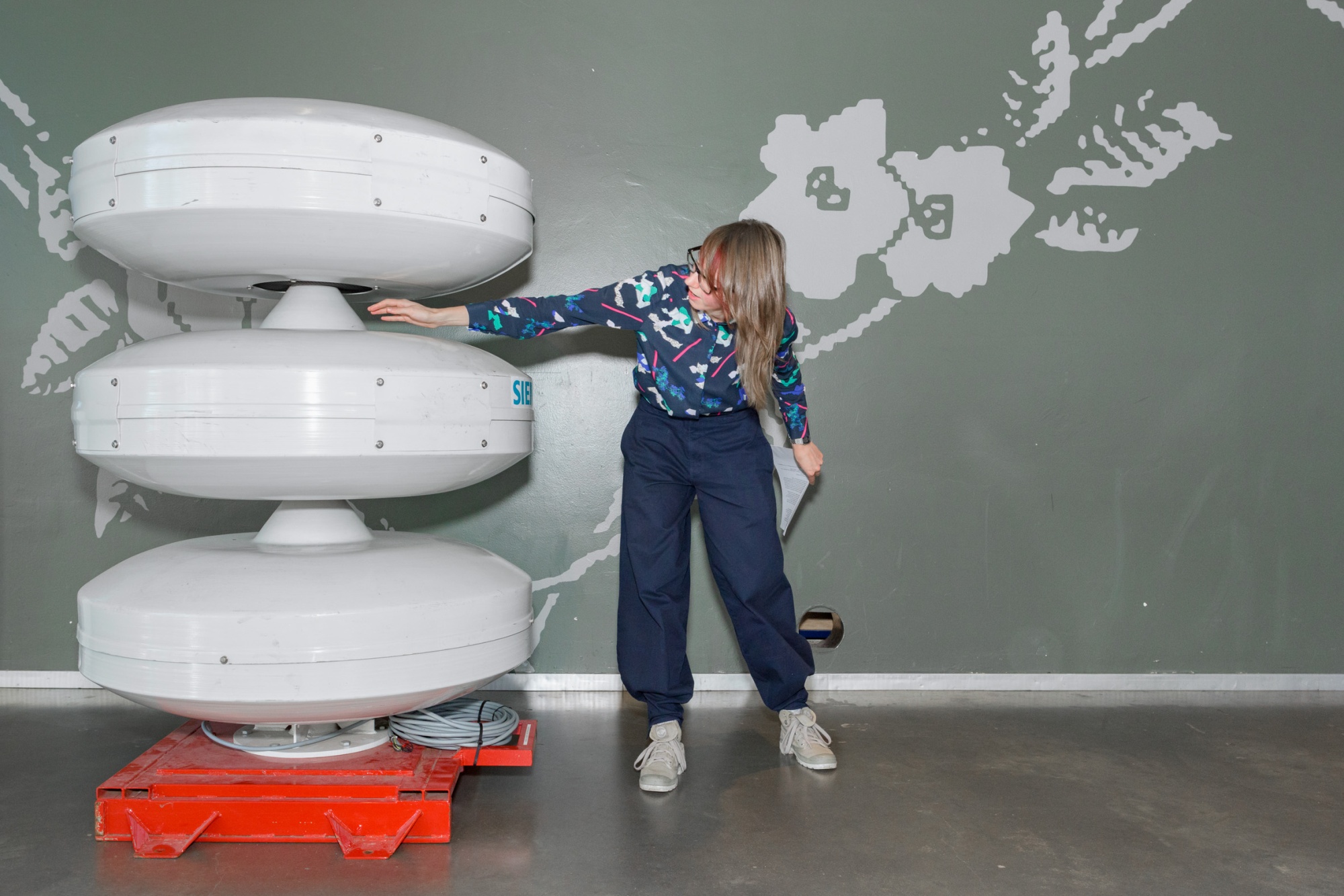
Fig. 4: Angela de Weijer presenting Collective Signal and explaining the siren’s workings at the 2017 November Music festival in ’s-Hertogenbosch, Netherlands. Courtesy Sas Schilten.
In addition, as mentioned above, each individual siren set has a control unit. This unit includes a radio receiver that enables remote control of the sirens; a sound generator drawing on digital sound samples, or sound files; and four preamplifiers for the speakers. Having De Weijer’s composition play through these speakers would have required taking a computer to each of the 4,287 siren sets to upload a new sound file to its control unit. This would have implied a deep and time-consuming breach of the maintenance routines of the Dutch Warning and Alarm System. De Weijer’s composition is not just a straightforward replacement of one sequence of sounds by another sequence of sounds. To have her swan song for the siren sounding just once, Siemens would have had to send technicians to every single siren across the country.
Siren materiality
On 3 June 2023, Collective Signal premiered, albeit in a revised version and with an alternative message coming along with it. This performance did not take place in the Netherlands, however. The Dutch government was still deliberating whether and when it would transition its alarm system from sirens to mobile phone alerts. Instead, Collective Signal sounded at a location in a country that may seem an unlikely choice at first sight: Monheim am Rhein, Germany. In the late 1930s, Dutch authorities had installed electric air raid sirens as air raid alerts in a mobilization effort against the threat of an invasion by German forces. How then did Collective Signal end up in Germany?
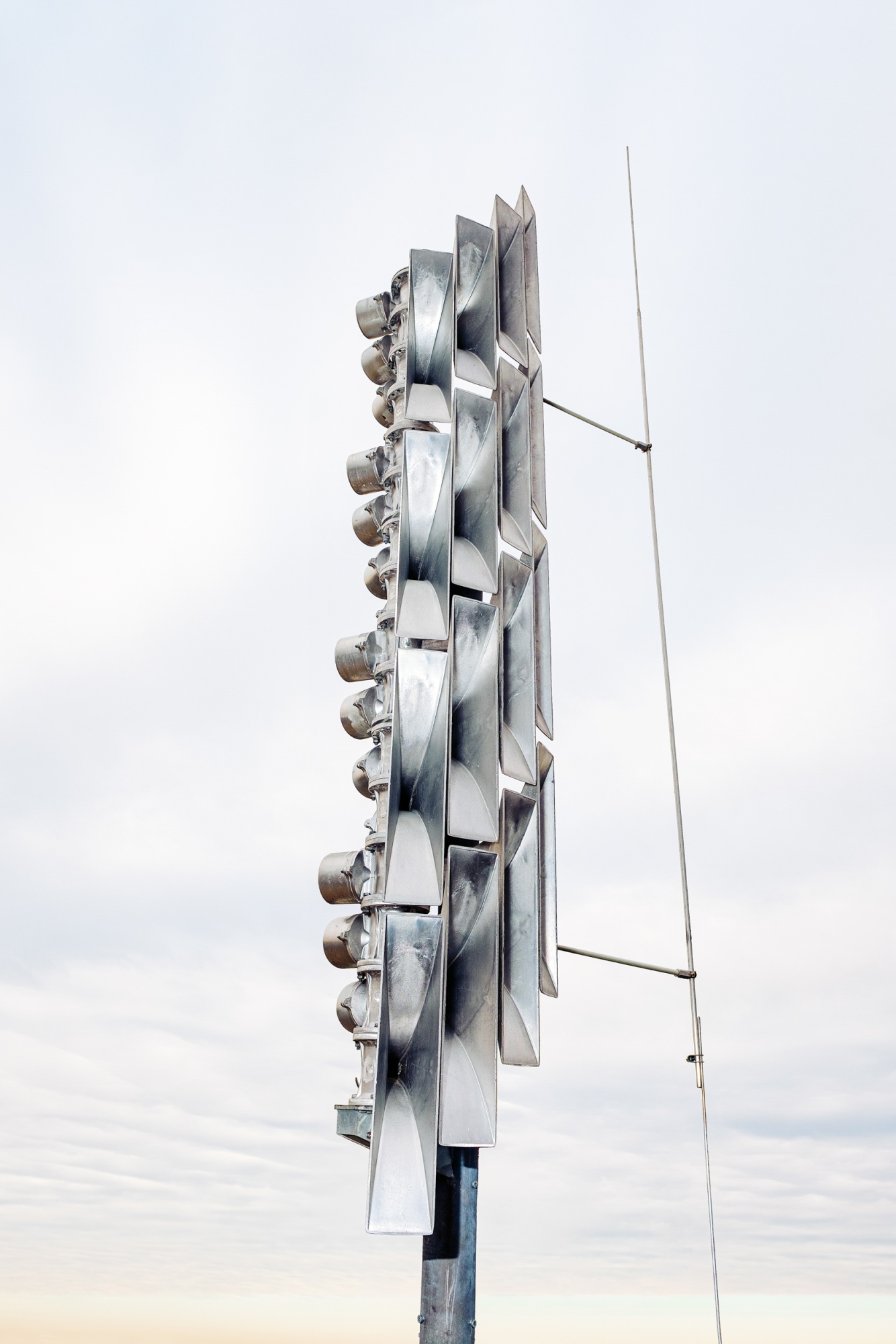
Fig. 5: One of the twelve Monheim sirens, in this case equipped with sixteen speakers. Courtesy Niclas Weber.
In fact, Monheim hosted the Monheim Triennale II, a festival for “contemporary improvised, composed, and popular music,” titled The Sound – Sonic Art in Public Spaces.22 In close collaboration with the Monheim municipality, the Triennale commissioned De Weijer to create a site-specific version of Collective Signal for Monheim am Rhein’s twelve sirens. These sirens are polyphonic, enabling a simultaneous broadcast of multiple sounds at various frequencies (or tones). The work acquired its eventual name Collective Signal – Monheim version after Monheim purchased the artwork.
On this occasion, De Weijer opted not for a single composition but, on the festival organizers’ request, five compositions – one for each Saturday of the sound art festival. During the last of five festival weekends, the fifth iteration repeated the very first, thus bringing Collective Signal – Monheim version full circle. In the seven years between her initial idea for the swan song in 2016 and the Monheim premiere in 2023, De Weijer deepened her skills as a composer, and aimed to enhance the composition’s sonic richness. However, it proved impossible to have the work last longer than one minute and 53 seconds, as the pre-amplifiers of the speakers would overheat when trespassing this technology-induced temporal boundary.
De Weijer’s sonic imaginations thus initially clashed with the technical limitations of the warning system itself, creating a potential breach of the siren’s materiality, or its character of being material. Although every traditional musical instrument comes with technical constraints in loudness, pitch range, and timbre, composers are usually familiar with these requirements before they start composing their work. In this case, however, the materiality of the sirens and their sound remained hidden as long as the sirens merely functioned as the cornerstones of the Monheim public warning system. The sirens’ limitations only played out once De Weijer aimed to turn the sound of the warning system into an artwork. The composer eventually resolved the issue through a series of brief compositions with a theme-and-variation structure. The ultimate embedding of the composition in the hardware of the Monheim sirens thus co-composed the work of art. In other words, Collective Signal – Monheim version is sound art enabled and constrained by Monheim’s public warning system.
Retraining: Signal into art
Similarly to the way the Dutch population needed to be trained to recognize and respond properly to the air raid sirens in the years leading up to World War II, the Monheim inhabitants had to be retrained to identify the sound of the sirens during the Triennale as art rather than as an alarm. The cover of the flyer intended to perform this retraining of the entire population thus featured five languages: German, English, Ukrainian, Arabic, and Turkish.
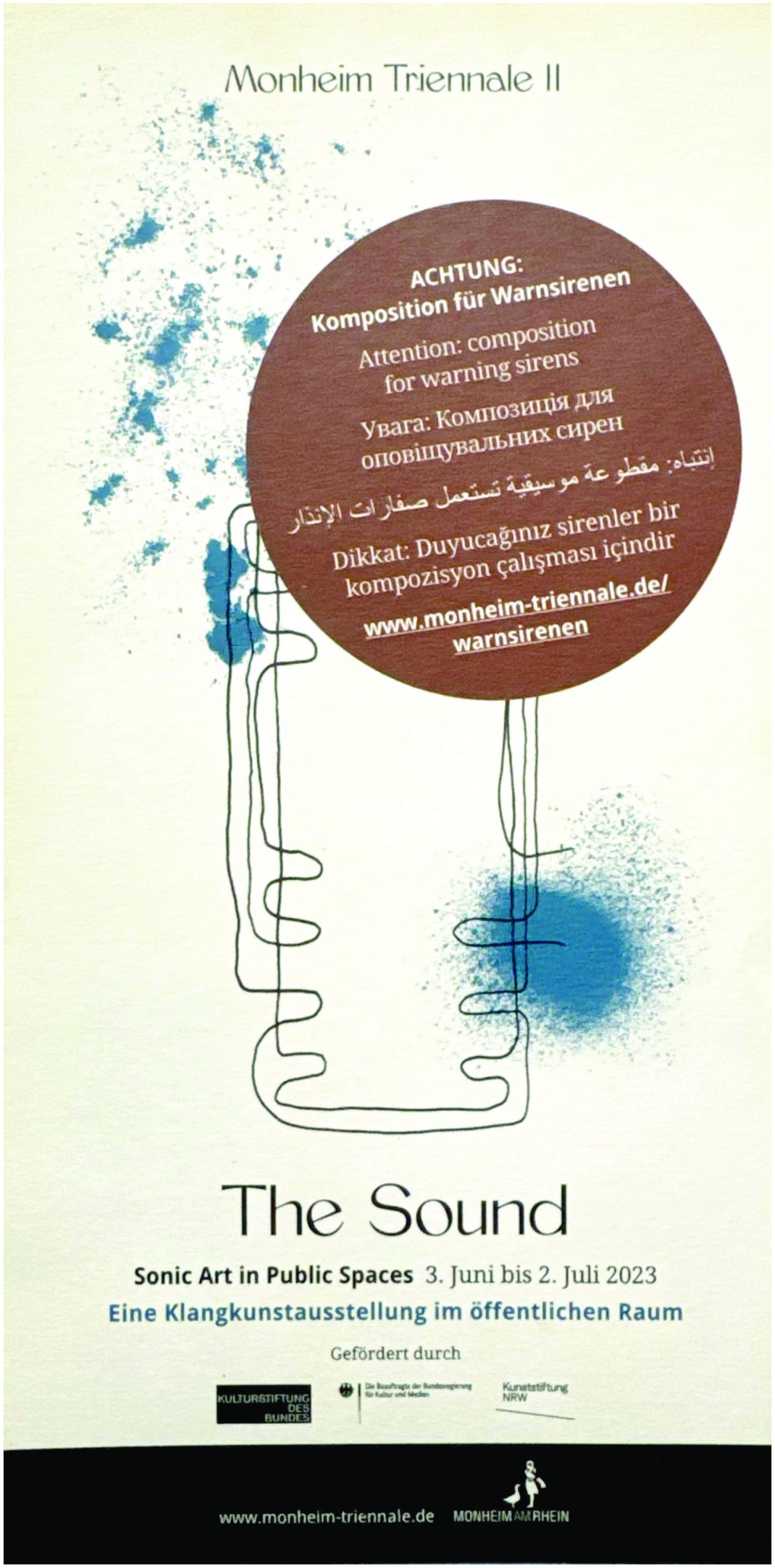
Fig. 6: Cover of the leaflet explaining Collective Signal – Monheim version to the Monheim population: “Attention: composition for warning sirens.” Courtesy Vasilis Marmatakis.
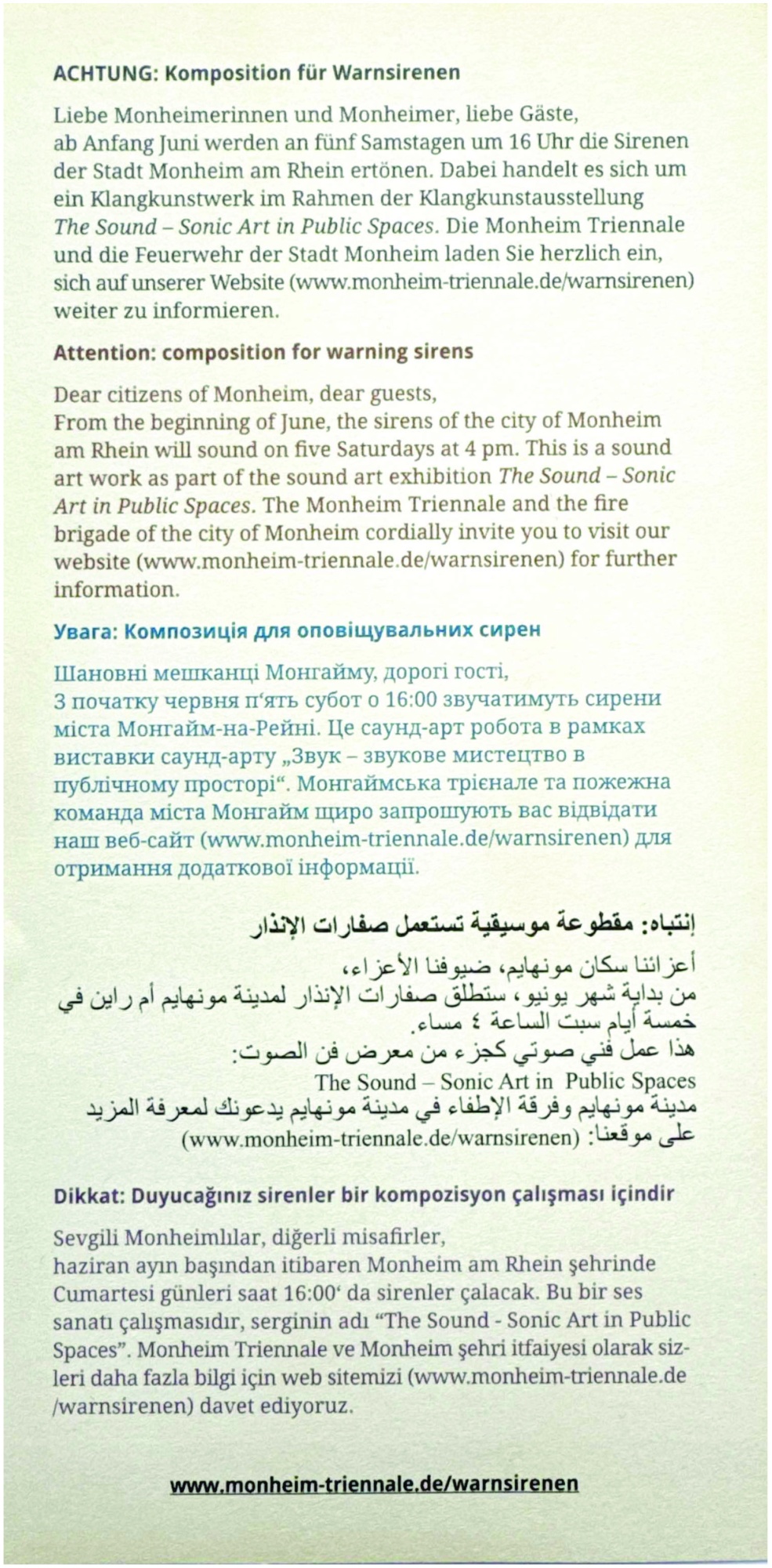
The leaflet’s reverse side provided additional detail, addressing both the citizens of Monheim and its visitors, announcing when the sirens would sound as part of the festival, and “cordially” inviting readers on behalf of the Monheim Triennale and “the fire brigade” to visit the website for further information.23
The web page itself – now only retrievable through an entry about De Weijer under the site’s archive button – explained that prior to playing the four compositions for sirens, “an all-clear signal” would be audible, “which is obligatory when using the sirens” and which is “not part of the compositions.” It also explained, in German and English, the background of both the original Collective Signal composition and its reworked version for Monheim. It claimed that “the perception of the siren” is usually negative, “much in keeping with its depiction in ancient mythology” in which the siren is a “creature whose beguiling song lures passing sailors” to their death. It went on to say that, in contrast,
Sirens also function as a measure of welfare. Sirens are installed for protection. A warning system that should increase our chances of survival. With this in mind, De Weijer introduces the local warning system as a tool for connection, embrace and comfort.24
The festival organizers thus went to great lengths to frame the event in positive terms. At the same time, they showed awareness of how the artwork as a breaching experiment – albeit without referring to that notion as such – might unnecessarily trigger the learned, habitual response to the sound of the siren as a warning signal. Hence the intriguing combination of situating the artwork in between a partially common use of the siren – with “Attention” in capitals and mentioning the all-clear signal – and the composition proper.
To some extent, their efforts appear to have been successful. A video clip by Rein de Wilde of the piece’s third performance on the afternoon of Saturday 23 June 2023, shows no signs of panic, disturbance, or concern among visitors in Monheim’s city centre. It seems to be business as usual, with people walking around, shopping, or sitting on the terrace. Of course, we do not know whether this was solely due to the published instructions, or to, for instance, the absence of war threat or other perceived risks at that particular moment among the Monheim population and visitors.
Yet as the newspaper Rheinische Post reported, both a test of the artwork and the final performances raised an extensive discussion in the Facebook community group Monheim Urgesteine. A post with the header “Stadtala[r]m in Monheim?” elicited over 300 comments. Although some of those involved considered the composition “wonderful,” triggering “goose bumps,” others commented sarcastically, comparing it to music by Metallica or Nirvana. Most responses actually expressed concern and disapproval, arguing that the artwork “misused” the alarm and was just “noise” “imposed” on the population.25 As one particularly intriguing comment read, “Real art is not obtrusive” (Echte Kunst ist nicht aufdringlich).26 Despite all precautions, the Monheim iteration of Collective Signal thus worked as a breach of both signal and art to many of those expressing their opinions within this Facebook group.
Siren infrastructure
In contrast, the Monheim municipality and Triennale organizers enthusiastically supported the creation and performance of the reworked version of Collective Signal, eventually leading to its acquisition by Monheim for the city art collection. Yet what prompted Monheim authorities to agree to playing the artwork in public space in the first place? Why did they comply with the need to have a technician from the siren manufacturer equip all twelve Monheim sirens with brand new audio files containing the composition – as would have had to happen for the 4,278 sirens in the Netherlands had Collective Signal premiered there? Why did the Monheim firefighters even accept such a breach of their siren infrastructure?
This was primarily the work of Monheim’s then mayor Daniel Zimmermann, a relatively young and ambitious person, and founder of PETO: a local leftist and culture-minded political party representing the voices of younger generations. Zimmermann fully embraced the Triennale as a way to put Monheim am Rhein on the map, appealing to business owners and employees. This attitude was crucial for the festival director and curators, enabling them to engage successfully with the local fire brigade.
In turn, the fire brigade was proud of its warning system. For them, the sirens were less about signalling danger and more about guaranteeing communal safety and security. De Weijer took their positive connotations seriously, and aimed to let these resound in her compositions. The four iterations therefore had “glitter,” “unite,” “anthem,” and “comms” as draft titles for internal communication purposes, later presented under the single name Collective Signal – Monheim version. Each of these iterations ended on a major harmonic triad. We invite you to listen to the audio clip.
Angela de Weijer explains her process of composing as follows:
For the Monheim version, I reprogrammed my Korg Prologue 8 synthesizer as I aimed for a sound less saw-tooth-oriented than the one I used for the 2018 version. The goal was to achieve a softer bell-like sound created from sine tones in order to reinforce the concept of the “new” siren as a system of care instead of scare. As the technicalities of the Monheim siren infrastructure – a HELIN system – allow playback of .mp3 files, it was indeed an option to stray from the saw-tooth sound and its regularly rising and declining frequency.
The second iteration is the one most close to the original Collective Signal composition. It reappears in the Monheim version to honour and celebrate the fact that the artwork materialized after all. With the new synth patch in place, I re-recorded it in a slower tempo, while removing the more decorative elements such as the drone sounds and basslines.
This updated version became the starting point for the other three compositions, yet tailored to the locale of Monheim am Rhein, about which I learned more by reading into the Monheim history and by strolling through the city. The Triennale organized a local work session eight months ahead of the festival in which I had the opportunity to meet key partners at the fire department. They allowed me to visit the control room and closely inspect the siren head, using a huge fire engine ladder.
A siren engineer joined to discuss technical details and to upload the 2018 version to one of the sirens closest to the Rhine so we could do one test run. The fire department’s chief provided me with technical documentation and a map of the sirens’ locations and reach, to help me with the composition process. A key detail on top of the issues of maximum duration and storage capacity was that the system’s output does not go below 170Hz, thus not allowing for deep bass parts.
Listening to global siren systems, and reading R. Murray Schafer’s description of bell and signalling towers in The Tuning of the World, were among the other sources of inspiration. Finally, I experimented with scales and their modalities to be mindful of sensitive listeners like children, refugees, neurodiverse people, and animals.
Collective Signal – Monheim version’s main theme, in the first and fifth iteration, is in F Lydian: slow, dreamy, and melancholic. Its third variation is in G Dorian. It is reflective, narrative and searching. The fourth, in D Mixolydian and with several arpeggios, is the most energetic, although it is also epic and affirming. As I said before, all the pieces end with a major drone chord.27
Epilogue and conclusions
It is December 2025. The end of the air raid siren in the Netherlands seems to be near. The Dutch government is running a campaign instructing citizens who already have the NL-Alert app installed on their mobile phone to inform others – older, less media-literate people – about the notifications they receive. With the death of the sirens in sight once again, Intro in Situ, a sound art and avant-garde music institute based at Maastricht, is working on another attempt to have the sirens play a new Collective Signal composition by De Weijer during the very last siren test round, in at least one place in The Netherlands. Whether this latest plan will succeed is unclear at this stage. What is clear is that the sound will probably breach sonic conventions, undo decades of sonic training, and open up deeply obdurate siren infrastructures.
These expectations draw on what we observed happening when Angela de Weijer aimed at (and ultimately succeeded in) turning the siren from public alarm into an instrument emanating a sounding artwork in public space. As Garfinkel’s breaching experiments uncovered the habitual fabric of everyday social life, De Weijer’s composition acted as a breaching experiment as well. Her sonic interventions in a collective signal uncovered what commonly remains hidden from the public eye: the longstanding sonic conventions embedded in the siren warning system, the routines of maintenance and training it requires, and the dependence on taken-for-granted infrastructures crucial to its functioning. It is good to know what is behind our alert sirens. Yet let them remain silent as long as possible, while sound art keeps sounding.
Acknowledgements
We would like to thank Michele Faguet for copy-editing this article and the Faculty of Arts & Social Sciences at Maastricht University for funding our collaboration with a Research Stimulation Fund Grant.
+++
Angela de Weijer (also known as Miss Milivolt)
is a multidisciplinary artist, composer, and DJ based in Eindhoven, Netherlands. In 2024-26, she was the Heerlen city composer. Since 2020, De Weijer has been one of three synthlords in the experimental-ambient-drone-EDM collective Drone Assembly.
Karin Bijsterveld
is a historian and full professor of Science, Technology and Modern Culture at Maastricht University. She is the author of Mechanical Sound (MIT 2008) and Sonic Skills (Palgrave 2019). With Anna Kvičalová, she co-edited “Forensic Voices,” a special issue of Sound Studies (2023) on sonic identification.
Noten
- Bakker, M., and others. Een toekomst voor het WAS? Nederlands Instituut voor Publieke Veiligheid, 2022, pp. 8 ff. ↩
- Bijsterveld, Karin. “Monument for the Air Raid Siren: Auditory Commemoration and the Mobilization of Collective Memory.” Sound and Memory, edited by Andreas Steen, Jacco Visser, and Wulf Kansteiner. De Gruyter (forthcoming). ↩
- Garfinkel, Harold. Studies in Ethnomethodology. Prentice Hall, 1967. ↩
- Vernacular Archive Nederlands Instituut voor Publieke Veiligheid (VA NIPV), “Geluidsselectie/mode selectie,” section 3.3.3.4, n.p.; VA NIPV, “Landelijke Faciliteit Rampenbestrijding, Waarschuwingsstelsel, Handleiding Voorbereiding Sirenelocaties, Versie 3, 20 februari 2006,” Appendix 1, p. 1. ↩
- Image Bank WO2, no. 63386, NIOD, beeldbankwo2.nl/nl/beelden/detail/124a8a60-025a-11e7-904b-d89d6717b464. Accessed 11 Apr. 2025. ↩
- “IFV wordt NIPV: van fysieke naar publieke veiligheid,” Vakblad Veiligheid, January 3, 2022, vakbladveiligheid.nl/ifv-wordt-nipv-van-fysieke-naar-publieke-veiligheid. Accessed 1 Aug. 2026. ↩
- Bakker and others, p. 12. ↩
- VA NIPV, “Geluidsselectie/mode selectie,” section 3.3.3.4, n.p. ↩
- René van der Merwe (retired Siemens employee, formerly associated with Siemens’s critical infrastructure department), personal communication by phone call, 3 Dec. 2025. ↩
- Zwikker, Cornelis. “Geluidvoortplanting en gehoorproblemen in verband met de geluidalarmeering.” Congres over de technische problemen bij geluidalarmeering, 28 Mar. 1940. De Geluidstichting, 1940, p. 5. ↩
- Zwikker, pp. 4-5, and Archives Nederlands Akoestisch Genootschap (Dutch Society for Acoustics), Files Loonmeetdienst, (Gasverdediging/Sirene 1936), Letter from Prof. Dr C. Zwikker to Lieutenant-General off duty (A. de Ridder), Inspecteur voor de Bescherming van de Bevolking tegen Luchtaanvallen (Inspector of Civil Air Defence), 4 Feb. 1937, p. 3. ↩
- Bijsterveld, Karin. “Sirene/Siren.” Uitgepakt: Instrumenten voor wetenschap en techniek in Centre Céramique/Unboxed: Instruments for Science and Technology in Centre Céramique, edited by Karin Bijsterveld, Verloren, 2021, pp. 42-45. ↩
- Bijsterveld, “Monument for the Air Raid Siren.” ↩
- Bosma, Koos. Schuilstad: Bescherming van de bevolking tegen luchtaanvallen. Uitgeverij SUN, 2006, p. 187. ↩
- Image Bank WO2, no. 106232, NIOD, beeldbankwo2.nl/nl/beelden/detail/5ce4498a-025a-11e7-904b-d89d6717b464. Accessed 11 Apr. 2025. Meijer was a member of the Nationaal-Socialistische Beweging (NSB), the Dutch national-socialist movement collaborating with the occupying Germans. Meijer voluntarily joined the Landwacht, the NSB auxiliary police, in 1944. His collaboration resulted in a conviction of four years’ jail after World War II, “‘Bij luchtalarm .. Onmiddellijk dekking zoeken!’: Object uitgelicht.” Historiek. Historiek.net. historiek.net/object-uitgelicht-bij-luchtalarm-onmiddellijk-dekking-zoeken/23527/. Accessed 10 Apr. 2025; “Bij luchtalarm..onmiddellijk dekking zoeken!” Collectie Verzetsmuseum. ↩
- Bijsterveld, “Monument for the Air Raid Siren.” ↩
- Bull, Michael. Sirens. Bloomsbury Academic, 2020, p. 44. ↩
- Yamada, Kuseike. “Mobilizing Citizens’ Ears: Aural Training as Civil Defense, 1941–45.” Technology and Culture, vol. 64, no. 2, 2023, pp. 359-78. ↩
- Bijsterveld, Karin. “Save Our Noise: When Sound Out of Place Deserves Our Protection.” Noise as Constructive Element in Music: Theoretical and Music-Analytical Perspectives, edited by Mark Delaere, Routledge, 2022, pp. 45-46. ↩
- Bull, p. 59. ↩
- VA NIPV, “Landelijke Faciliteit Rampenbestrijding, Waarschuwingsstelsel, Handleiding Voorbereiding Sirenelocaties, Versie 3, 20 februari 2006,” Appendix 3, pp. 3-4. ↩
- Monheim Triennale website. monheim-triennale.de/en/about. Accessed 10 Apr. 2025. ↩
- Leaflet “The Sound,” Monheim Triennale II. ↩
- Angela de Weijer. Monheim Triennale website, archiv.monheim-triennale.de/en/mt2/2023/artists/angela-de-weijer. Accessed 10 Apr. 2025. ↩
- Gutmann, Thomas. “Die Triennale beginnt mit Sirenen-Klang.” Rheinische Post, Update 3 June 2023. Rheinische Post Online, rp-online.de/nrw/staedte/langenfeld/das-bietet-die-monheim-triennale-2023-zum-auftakt now available at archive.is/hNUj5. Accessed 10 Apr. 2025. ↩
- Email from Angela de Weijer to Karin Bijsterveld, 25 Feb. 2025, in reaction to a post in the Facebook group Monheim Urgesteine. ↩
- Email correspondence between Angela De Weijer and Karin Bijsterveld, 19 Apr. 2025. ↩
Meer in dit thema

Kunst als taal. Een antwoord op Lesages "Tegen het supplement"
Nicolas Baeyens
Broken View. Belgisch-Congo en de magische lantaarn
Hannes Verhoustraete